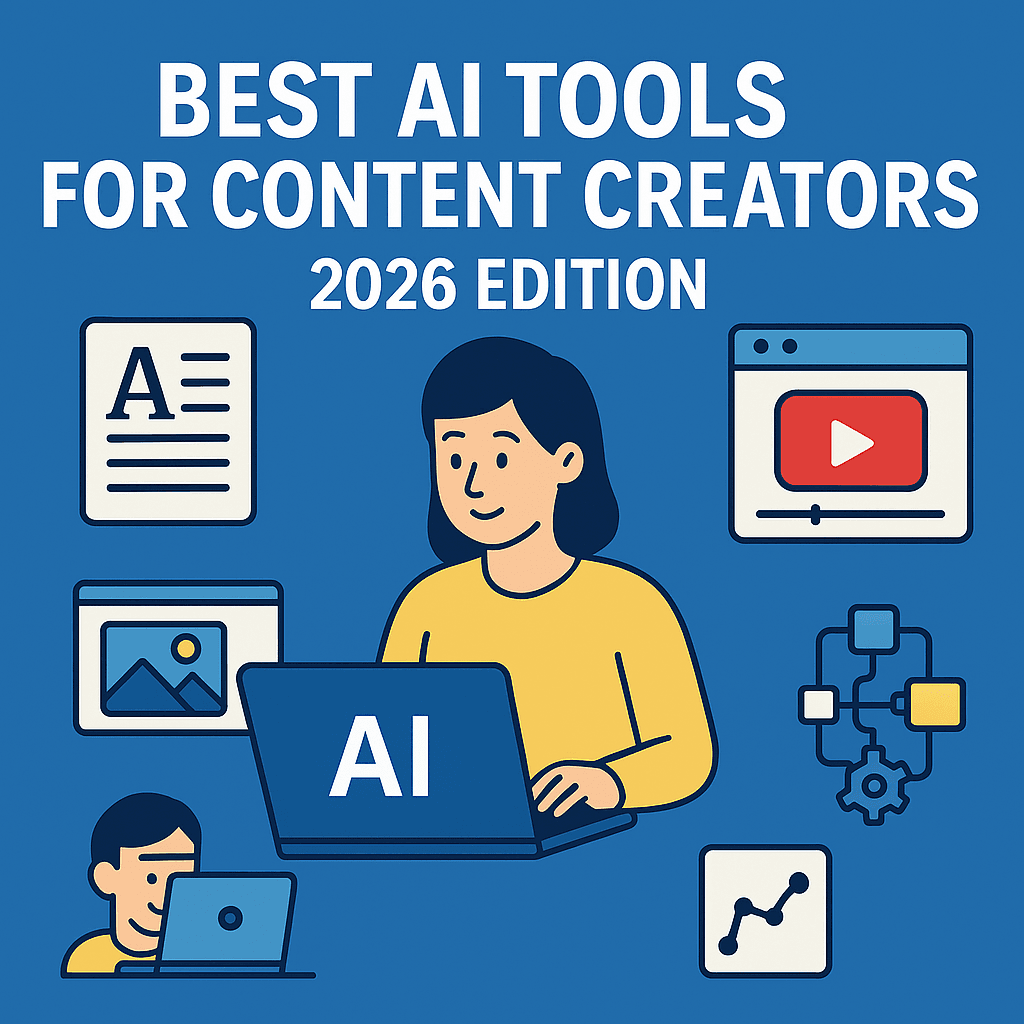
The AI landscape keeps shifting fast — new models, maker-focused features, and integrated creative suites are transforming which tool is the best AI tool for content creators (2026 edition). In this guide I’ll explain the top contenders, use-cases (writing, images, video, audio, automation), recommended workflows, and an SEO-ready article blueprint you can adapt for your blog or website.
H2 — Why choosing the right AI tool matters today
AI is no longer a single “assistant” — it’s a stack. Writers need strong language models, designers need generative images and templates, and video creators need editor-grade automation. The right AI tool can:
- cut content production time by 3–10x,
- improve consistency across channels, and
- let small teams compete with big studios.
That means picking the best AI tool for content creators (2026 edition) depends on your niche (YouTube, blogs, social shorts, newsletters) and the creative stage you want to accelerate (ideation, draft, edit, distribution).
H2 — Top AI tools for content creators (shortlist & strengths)
Below are the tools that dominate creator workflows. This list highlights what each tool is best at and when to use it.
H3 — GPT-family models (ChatGPT / GPT-4o and successors) — best for ideation & long-form writing
OpenAI’s GPT line remains a go-to for rapid ideation, outlines, scripts, SEO-driven blog drafts, and multimodal tasks (text + images + audio).
H3 — Canva Magic Studio — best for fast design + social-ready visuals
Canva’s Magic Studio (Magic Write, Magic Design, AI image & video tools) turns briefs into social graphics, carousels, and short videos in minutes — great for creators who need consistent design output.
H3 — Jasper (and other writing-focused assistants) — best for marketing copy
Jasper remains strong when you need brand voice control, marketing copy templates, SEO integrations, and team collaboration.
H3 — Descript & Runway — best for audio/video editing and repurposing
Descript simplifies transcript-based editing and podcast workflows; Runway offers generative video tools and frame-level editing.
H3 — Synthesia, Pictory & specialized video AI — best for avatar-driven or automated video creation
Platforms like Synthesia create multilingual avatar videos, while tools like Pictory convert long videos into short, captioned social clips.
Short takeaway: There is no single “best AI tool for content creators (2026 edition)” — the best pick depends on whether you prioritize writing, visuals, video editing, or workflow automation.
H2 — How to pick the best AI tool for content creators (2026 edition) — framework
Use this decision framework:
- Output type — blog (text), YouTube (video), Instagram (visual), podcast (audio).
- Quality vs speed — do you need broadcast quality or fast social content?
- Multimodal needs — one tool for text + images + audio or specialized tools?
- Budget & scale — monthly vs enterprise, API options.
- Data & brand safety — hallucination control, brand guardrails, IP rights.
H2 — SEO strategy: writing an article titled “Best AI tool for content creators (2026 Edition)”
Below is an on-page SEO blueprint you can use.
H3 — Keyword strategy & “keyword stuffing” (smart, not spammy)
Primary keyword: Best AI tool for content creators (2026 Edition)
Secondary keywords: AI tools for content creators, best AI tools for creators, AI video editor, GPT for creators, Canva AI tools.
How to use them naturally:
- Title & H1 — include primary keyword once.
- First 100 words — include primary keyword once.
- H2s — include secondary keywords where natural.
- Body — repeat primary keyword 3–5 times across 1200+ words.
- Meta description — include primary keyword once.
“Proper keyword stuffing” today means strategic repetition & semantic variation — not spam.
H2 — Internal & external link strategy (very important for SEO)
H3 — Internal links (examples & anchor text)
Use internal links to boost topic relevance:
- Link to your pillar post:
/blog/ai-tools-comparison— anchor: AI tools comparison - Link to tutorials:
/guides/gpt-scripts-for-youtube— anchor: GPT scripts for YouTube - Link to category pages:
/tools/video— anchor: AI video tools
H3 — External links (authority building)
Use external links to trustworthy sources:
- “OpenAI GPT overview”
- “Canva Magic Studio page”
- “Descript official website”
- “Runway AI video tools”
Include at least 3–4 external links for trust & authority.
H2 — Content workflow examples (for different creator types)
H3 — Blog + newsletter creators
- Generate topic ideas using GPT.
- Create outline + meta tags.
- Draft long-form articles.
- Optimize headings + schema.
- Create visuals using Canva.
- Add internal links and publish.
H3 — YouTube creators
- Generate scripts, hooks, and titles with GPT.
- Use Descript for editing + auto captions.
- Use Runway for advanced effects.
- Use Canva for thumbnails.
- Repurpose content into shorts using AI tools.
H2 — Ready-to-use article structure template
- H1: Best AI Tool for Content Creators (2026 Edition)
- Intro
- H2: Why AI tools matter
- H2: Top tools list
- H2: How to choose the best tool
- H2: Use-case workflows
- H2: Internal & external linking strategy
- Conclusion
- FAQs
Conclusion
There isn’t a single definitive best AI tool for content creators (2026 edition) — but there is a best tool for your specific workflow. Writers should rely on GPT-family models; graphic creators benefit from Canva Magic Studio; video-first creators need Descript/Runway; marketers often prefer Jasper.
A powerful strategy is combining tools:
GPT for ideation + Canva for visuals + Descript for video = complete production stack.
FAQs
Q1 — Which one tool should I buy if I have a low budget?
Choose a multimodal LLM like GPT for ideation, writing, and planning — it covers the widest content needs.
Q2 — Are AI images safe for commercial use?
Most tools allow commercial usage but licenses differ. Always check the tool’s usage rights.
Q3 — How often should I update my tools list article?
Every quarter — AI tools improve very fast.
Q4 — Can I rely only on AI for writing?
AI is great for drafting, but human editing improves accuracy and brand voice.
Q5 — What are the most important internal links to include?
Link to your pillar pages, category pages, and tutorials to increase topical authority.